I have been a big fan of Dan Bigiham for awhile now and in fact I model a lot of Dan’s principles with my own coaching. When we are told to “reverse engineer” your gaols, what does this really mean?
Following on from my last post on “Money Ball for triathlon”, I again will use myself as an example for this so let’s take a look at using Dan Bigham “start at the end” approach for Ironman triathlons.
This is a high-performance experiment, so the detail will reflect that.
Target: Ironman Cairns 2026 – Sub 9:45 or 9:30 as a stretch goal
Conditions: ~ 25-28°C, humid, strong winds, rough swim, rolling bike and hot flat run
Step 1: Define the end point – What performance do you need?
Goal: 9:30 – 9:45 total time
Swim: (3.8km) 1:05 (stretch 1:00) within AG pack, low cost
Bike: (180km) 4:55 – 5:05 NP of 220watts, focus on aerodynamics and decoupling
Run: (42.2km) 3:20 – 3:30 HR controlled, low fade
T1 + T2: 5-10min fast but calm
**** This sets the benchmark for all the backward planning ****
Step 2: What does that require physiologically?
Swim:
Threshold pace: ~1:33/100m for a 1:00 swim
Cadence goal: 36+ SPM, even stroke count
High focus on form and drag minimization
Bike:
Race: NP: 220w required LT2 ~310-320 watts for a 70% IF
Bike Vi: <1:03, stay aero and even
CdA goal ~0.220 or lower
Caloric demand: ~3300–3600 kcal → high carb intake (120g/hr)
Run
Race pace: ~4:50/km (3:24 marathon)
HR: 145–150 bpm
Substrate use: Must be able to burn fat efficiently at this pace
Tolerate 90–100g/hr carbs
Step 3: Environmental Reality – Heat in Cairns
Must mitigate core temp rise
Clothing, pacing, and fuelling must all support thermoregulation
Taking the concept from the hit movie Money Ball where Billy Beane looks for undervalued players to build his team, we look at what this may look like for age group triathlon. I will use myself as an example for this.
So if we ignore traditional metrics that seem impressive, and instead focus on efficiency, marginal gains, undervalued performance indicators and data driven strategy.
The Ironman Moneyball Strategy
Mission: Podium in 45-49 age group at Ironman cairns 2026 in 9:30-9:45
Philosophy: Outthink, out-plan, out-measure and out-execute the competition using undervalued performance leavers.
Performance Metrics That Matter Most (Undervalued Metrics)
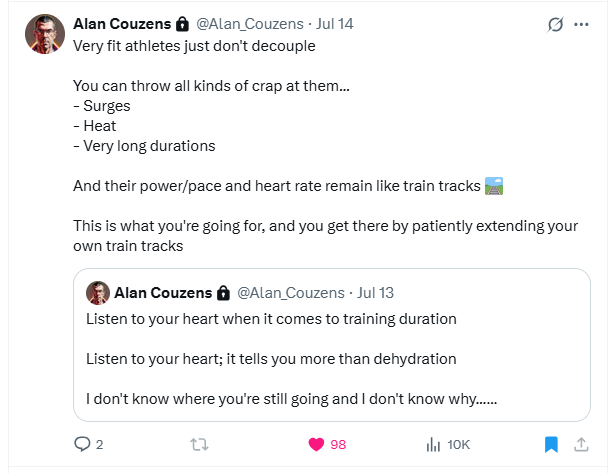
Decoupling (efficiency under fatigue) A major differentiator in my run
Swim SPM and DPS interaction (not just pace) for a sustained 1:35-1:40 at low cost
% of LT1 sustainable for 5hrs on the bike: real race limiter.
Muscle resilience (long runs off the bike at tempo) – More predictive than VO2max.
Fatmax power output drift (Bike 135bpm and run145bpm over months)
Sleep quality + HRV trends, not just single day values
Nutrition absorption (real time gut tolerance > theoretical carb targets)
Drop in watts from road bike to TT position
Overvalued Metrics (ignore or treat with caution)
FTP (without specificity to race duration)
CTL alone (without breakdown to discipline)
VO2max (except to track health trends)
Max weekly hours (volume – unless executed right)
Swim volume without purpose
Moneyball Tactics by Discipline
Swim
Objective 1:05 swim @ <140bpm
Key Efficiency Metric: Strokes per minute (70spm with 0.92+ DPS)
Tactics:
12 week cadence boost block with swim cords + tempo trainer
No garbage yardage: every swim = aerobic foundation + threshold or tech
Open water race-pace start drills and group positioning work (start fast, settle early)
Bike
Objective: 5hr @ 220NP with <140bpm and CdA <0.26
Key efficiency Metric: Time to decoupling at Fatmax + Aero watts/wkg (not just FTP)
Tactics:
TT position ROI: Raise power in aero via Steve Neal-Style SE work and rolling 45min intervals @ 135bpm
Winter ROI block: Improving LT1 and SE with 250 TSS weekly = low risk/high reward
It has become a very big focus in pro cycling in recent years that coaches focus heavily on durability (fatigue resistance) and model a lot of the athlete’s training and nutrition around this principle.
An example of this would be early on in a ride complete a 5min all out effort followed by riding 3000 kilojoules of work while keeping power around 95% of LT1, then repeating the 5min all out effort again and analysing the power differences between the two 5min efforts. Ideally the coach is looking for a power fade between 0-3%.
We are starting to see this lean into triathlon but what and how to test for durability for Ironman athlete.
Bike Test: 4-5 hour ride with 6x 30min @ Ironman Power (70-75% of FTP or 95% of LT1)
Data to Collect: • Average Power • Heart rate • Lactate test (if you own a lactate tester)
Analysis: Comparing the following from the first interval to the last interval • Power drift • Heart rate drift • Lactate drift